 |
| Obra de Lu Cong |
CANCIÓN
Escuchen: había una cabeza de cabra colgando en un árbol.
Toda la noche colgó ahí y cantó. Y aquellos que la oyeron
sintieron una herida en su corazón y creyeron que escuchaban
la canción de un pájaro nocturno. Se levantaron de sus camas
y luego se acostaron de nuevo. En el viento de la noche la cabeza de la cabra
se balanceó de un lado a otro y desde lejos brillaba débilmente,
igual que la luna se reflejaba por millas en la línea del tren
junto a la cual yacía el cuerpo sin cabeza de la cabra. Unos muchachos
le cortaron la cabeza. Fue más difícil de lo que se imaginaron.
La cabra lloró como un hombre y les dio pelea. Pero ellos
terminaron el trabajo. Colgaron la cabeza sangrante cerca de la escuela
y después se fueron corriendo en la oscuridad que parece ocultarlo todo.
La cabeza colgó en el árbol. El cuerpo se quedó en las vías.
La cabeza llamaba al cuerpo. El cuerpo a la cabeza.
Se extrañaban mutuamente. La ausencia creció entre ellos,
hasta que arrancó el corazón del cuerpo, hasta
que el ahogado corazón voló hacia la cabeza, como las aves
de vuelta a su jaula y a la conocida percha donde trinan.
Entonces el corazón cantó en la cabeza, suave y luego fuerte;
cantó mucho rato y bajito hasta que la luz de la mañana apareció sobre
la escuela y el árbol; entonces el canto se detuvo.
La cabra perteneció a una muchachita. Le había puesto
Espina Rota Dulce Mora, nombrada así
por el arbusto de estrellas de la noche, porque el sedoso pelo de la cabra
era oscuro como el agua de un pozo, porque tenía ojos como frutos silvestres.
La muchacha vivía cerca de una vía férrea elevada. En la noche
ella escuchaba el tren pasar, el dulce sonido del pito del tren
se derramaba suave sobre su cama, y cada mañana ella se levantaba
para darle a la cabra que balaba su balde de leche dulce. Le cantaba
canciones sobre muchachas con sogas y cocineros en barcos.
La peinaba con un peine duro. Soñaba diariamente
que la cabra se haría más grande, y lo hizo. Ella pensó
que su ensueño lo había logrado. Pero un día la muchacha no escuchó el tren
y a la mañana siguiente se despertó ante un jardín vacío. La cabra
ya no estaba. Todo se veía raro. Era como si una tormenta
hubiese pasado mientras dormía, viento y piedras, lluvia
que arrancó las ramas frutales. Ella supo que alguien
había robado la cabra y que había venido a causar daño. Llamó
a la cabra. Toda la mañana y durante la tarde, llamó
y llamó. Caminó y caminó. En su pecho un mal presentimiento,
como el presentimiento de las piedras cuyos bordes se erosionan
bajo los pies descalzos. Entonces alguien encontró el cuerpo de la cabra
por la vía elevada, las moscas alrededor llenaban sus suaves botellas
en el cuello rasgado. Luego otro descubrió la cabeza
colgando en el árbol de la escuela. Se apresuraron
a ocultar las partes para que la muchacha no las viera.
Corrieron para recaudar plata para comprarle otra cabra.
Corrieron para encontrar a los responsables, para oírlos
decir que había sido una broma, nada más que una broma…
Pero escuchen: el punto es este. Los muchachos pensaron
en divertirse y listo. Fue más duro
de lo que se imaginaron –ese tonto sacrificio– pero terminaron el trabajo.
Silbando mientras se lavaban sus grandes manos en la oscuridad,
lo que no sabían era que la cabeza de la cabra ya estaba
cantando tras ellos en el árbol. Lo que no sabían
era que la cabeza seguiría cantando, solo para ellos,
mucho después de que hubiesen bajado las sogas y que ellos aprendieran a escuchar;
balde tras balde, golpe tras golpe, ellos se despertarían
en la noche creyendo que escuchaban el viento entre los árboles
o un pájaro nocturno, pero su corazón latiría más rápido. Habría
un silbido, un zumbido, un murmullo fuerte, y al final, una canción.
La humilde canción que cantan unos muchachos perdidos que recuerdan el llamado de
su madre.
No una canción cruel, no, no, para nada cruel. Esta canción
es dulce. Sí, es dulce. El corazón muere por su dulzura.
SONG
Listen: there was a goat’s head hanging by ropes in a tree.
All night it hung there and sang. And those who heard it
Felt a hurt in their hearts and thought they were hearing
The song of a night bird. They sat up in their beds, and then
They lay back down again. In the night wind, the goat’s head
Swayed back and forth, and from far off it shone faintly
The way the moonlight shone on the train track miles away
Beside which the goat’s headless body lay. Some boys
Had hacked its head off. It was harder work than they had imagined.
The goat cried like a man and struggled hard. But they
Finished the job. They hung the bleeding head by the school
And then ran off into the darkness that seems to hide everything.
The head hung in the tree. The body lay by the tracks.
The head called to the body. The body to the head.
They missed each other. The missing grew large between them,
Until it pulled the heart right out of the body, until
The drawn heart flew toward the head, flew as a bird flies
Back to its cage and the familiar perch from which it trills.
Then the heart sang in the head, softly at first and then louder,
Sang long and low until the morning light came up over
The school and over the tree, and then the singing stopped....
The goat had belonged to a small girl. She named
The goat Broken Thorn Sweet Blackberry, named it after
The night’s bush of stars, because the goat’s silky hair
Was dark as well water, because it had eyes like wild fruit.
The girl lived near a high railroad track. At night
She heard the trains passing, the sweet sound of the train’s horn
Pouring softly over her bed, and each morning she woke
To give the bleating goat his pail of warm milk. She sang
Him songs about girls with ropes and cooks in boats.
She brushed him with a stiff brush. She dreamed daily
That he grew bigger, and he did. She thought her dreaming
Made it so. But one night the girl didn’t hear the train’s horn,
And the next morning she woke to an empty yard. The goat
Was gone. Everything looked strange. It was as if a storm
Had passed through while she slept, wind and stones, rain
Stripping the branches of fruit. She knew that someone
Had stolen the goat and that he had come to harm. She called
To him. All morning and into the afternoon, she called
And called. She walked and walked. In her chest a bad feeling
Like the feeling of the stones gouging the soft undersides
Of her bare feet. Then somebody found the goat’s body
By the high tracks, the flies already filling their soft bottles
At the goat’s torn neck. Then somebody found the head
Hanging in a tree by the school. They hurried to take
These things away so that the girl would not see them.
They hurried to raise money to buy the girl another goat.
They hurried to find the boys who had done this, to hear
Them say it was a joke, a joke, it was nothing but a joke....
But listen: here is the point. The boys thought to have
Their fun and be done with it. It was harder work than they
Had imagined, this silly sacrifice, but they finished the job,
Whistling as they washed their large hands in the dark.
What they didn’t know was that the goat’s head was already
Singing behind them in the tree. What they didn’t know
Was that the goat’s head would go on singing, just for them,
Long after the ropes were down, and that they would learn to listen,
Pail after pail, stroke after patient stroke. They would
Wake in the night thinking they heard the wind in the trees
Or a night bird, but their hearts beating harder. There
Would be a whistle, a hum, a high murmur, and, at last, a song,
The low song a lost boy sings remembering his mother’s call.
Not a cruel song, no, no, not cruel at all. This song
Is sweet. It is sweet. The heart dies of this sweetness.
(1994)
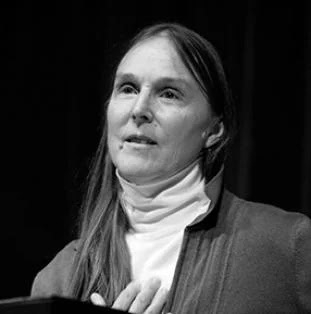 |
| Ph Brian Palmer |
Brigit Pegeen Kelly
(Palo Alto, Ca., EE.UU., 1951-2016)
de Song, BOA Editions Ltd., Brockport, NY, 1995
y en Poems: Song and the Orchad, Carcanet, 2008
Traducción de Gustavo Solórzano-Alfaro
publicado originalmente en CÍRCULO DE POESÍA
para leer más en KENYON REVIEW
publicado originalmente en CÍRCULO DE POESÍA
para leer más en KENYON REVIEW
y en POETAS SIGLO XXI


