Mostrando entradas con la etiqueta lisa rose bradford. Mostrar todas las entradas

10 de noviembre de 2021

Louise Erdrich, Remedio para el amor (+2)


Fotografía de Gregory Crewdson
REMEDIO PARA EL AMOR
                                  
Para Lise

Aún sigue lloviznando
en Wahpeton. Las pickups
chisporrotean bajo la luz de neón
de las antimoscas de la heladería.

Theresa sale con una remerita verde y cadenas
que brillan en su garganta.
Esta libélula, mi hermana,
encaja mejor que yo
en esta noche de aguas crecientes.

El Río Rojo se agranda para tragarse el puente.
Ella se ríe y deja a su macho en el Dodge.
Él desatraca para buscarla
dejando un surco largo en la neblina.

Y más tarde, en la cresta de la inundación,
cuando los pilotes se arrancan de sus anclajes
y se tiran a la corriente,
ella tropieza contra los puñetazos de un hombre.
Se hunde en el pasto mojado
y una bota le planta su mueca
entre las arcadas de la cara.

Ahora va a tientas hacia su casa en la oscuridad.
El blanco violeta de los faroles de la calle
hierve de insectos,
y los árboles se inclinan doloridos y vacíos.
El río pega contra la estructura del dique, insistente.

La encuentro hecha un ovillo en las raíces de un álamo plateado.
La encuentro tendida en la plaza, donde toda la noche
los animales dan vueltas en sus jaulas.
La encuentro en una cuneta quemada, en un campo
que se atraganta con la lluvia,
ráfagas de lluvia barren de arriba abajo
hasta ese río aferrado al puente.

Vemos que ahora la masa de la luna se ha levantado y el agua,
tan profunda como puede fluir,
deja de crecer. Esperamos que la noche nos lleve adonde
cesa la lluvia. Hermana, no hay nada
que no me animaría a hacer.

RiL Editores, 2010
Traducción de Lisa Rose Bradford

LOVE MEDICINE

For Lise

     Still it is raining lightly
     in Wahpeton. The pickup trucks
     sizzle beneath the blue neon
     bug traps of the dairy bar.

     Theresa goes out in green halter and chains
     that glitter at her throat.

     This dragonfly, my sister,
     she belongs more than I
     to this night of rising water.

     The Red River swell to take the bridge.
     She laughs and leaves her man in his Dodge.
     He shoves off to search her out.
     He wears a long rut in the fog.

     And later, at the crest of the flood,
     when the pilings are jarred from their sockets
     and pitch into the current,
     she steps against the fistwork of a man.
     She goes down in wet grass
     and his boot plants its grin
     among the arches of her face.

     Now she feels her way home in the dark.
     The white-violet bulbs of the streetlamps
     are seething with insects,
     and the trees lean down aching and empty.
     The river slaps at the dike works, insistent.

     I find her curled up in the roots of a cottonwood.
     I find her stretched out in the park, where all night
     the animals are turning in their cages.
     I find her in a burnt-over ditch, in a field
     that is gagging on rain,
     sheets of rain sweep up down
     to the river held tight against the bridge.

     We see now that the moon is leavened and the water,
     as deep as it will go,
     stops rising. Where we wait for the night to take us
     the rain ceases.  Sister, there is nothing
     I would not do.


de Jacklight, New York: Henry Holt and Company, 1984, 1990


B O N U S  T R A C K 

What happens when you let an unsatisfactory 
present go on long enough? 
It becomes your entire history.”


LOUISE DIXIT
"La vida te romperá. Nadie puede protegerte de eso, ni el estar solo, porque la soledad también te destruirá con su deseo. Tienes que amarla. Tienes que sentir. Es la razón por la que estás aquí en la tierra. Tienes que arriesgar tu corazón. Estás aquí para ser tragado. Y cuando sucede que estás roto, o traicionado, o abandonado, o herido, o que la muerte se acerca demasiado, siéntate junto a un manzano y escucha las manzanas que caen a tu alrededor en montones, desperdiciando su dulzura. Dite a tí mismo que probaste todo lo que pudiste."

Life will break you. Nobody can protect you from that, and living alone won't either, for solitude will also break you with its yearning. You have to love. You have to feel. It is the reason you are here on earth. You are here to risk your heart. You are here to be swallowed up. And when it happens that you are broken, or betrayed, or left, or hurt, or death brushes near, let yourself sit by an apple tree and listen to the apples falling all around you in heaps, wasting their sweetness. Tell yourself you tasted as many as you could.


Louise Erdrich 
(Little Falls, Minnesota, EE.UU., 1954) 
Reside en en Minneapolis, Minnesota
Miembro registrada de la nación Anishinaabe 
(también conocida como Ojibwa y Chippewa) 
NOVELISTA/POETA/ESCRITORA PARA NIÑOS/LIBRERA
para escucharla recitar en poema en LIBRARY OF CONGRESS
web de su librería BIRCHBARK BOOKS

16 de octubre de 2019

Denise Levertov, Los mudos


Fotografía de Jenn Violetta, de la serie The Company of Wolves

LOS MUDOS

Esos gruñidos que los hombres usan 
al cruzarse con una mujer en la calle 
o en la escalera del subte

para decirle que es hembra
y que su carne lo reconoce,

¿son una especie de melodía,
un canto algo feo, cantado
por un pájaro de lengua partida

pero lanzados en pos de música?

¿O son rugidos asfixiados
de un sordomudo atrapado en un edificio
que lentamente se llena de humo?

Ambos, tal vez.

Esos hombres por lo general
no parecen ser capaces de hacer más que gemir,
sin embargo, una mujer, a pesar de sí misma,

sabe que le rinden homenaje:
si careciera de toda gracia
pasarían en silencio:
entonces no es sólo para decirle que ella es
un cálido agujero. Es una palabra

en lengua-pena, nada que ver con lo
primitivo o una lengua-prima;
una lengua magullada, contagiada, precipitada

hacia la decrepitud. Ella quisiera
deshacerse del homenaje, dis-
gustada, y no puede,

sigue zumbando en sus oídos,
cambia el ritmo de su andar, 
los afiches rotos en un pasillo vacío

le hacen eco,
rechinan con el estertor del tren que arriba.
Su pulso reticente

se acelera,
pero bajan de velocidad los vagones
y se sacuden al detenerse mientras su comprensión

sigue traduciendo:
"vida tras vida tras otra vida pasa

sin poesía,
sin decoro,
sin amor."

Traducción de Lisa Rose Bradford

THE MUTES

Those groans men use
passing a woman on the street
or on the steps of the subway

to tell her she is a female
and their flesh knows it,

are they a sort of tune,
an ugly enough song, sung
by a bird with a slit tongue

but meant for music?

Or are they the muffled roaring
of deafmutes trapped in a building that is
slowly filling with smoke?

Perhaps both.

Such men most often 
look as if groan were all they could do,
yet a woman, in spite of herself,

knows it's a tribute:
if she were lacking all grace
they'd pass her in silence:

so it's not only to say she's
a warm hole. It's a word

in grief-language, nothing to do with
primitive, not an ur-language;
language stricken, sickened, cast down

in decrepitude. She wants to
throw the tribute away, dis-
gusted, and can't,

it goes on buzzing in her ear,
it changes the pace of her walk,
the torn posters in echoing corridors

spell it out, it
quakes and gnashes as the train comes in.
Her pulse sullenly

had picked up speed,
but the cars slow down and
jar to a stop while her understanding

keeps on translating:
'Life after life after life goes by

without poetry,
without seemliness,
without love.'

de The Sorrow Dance, J. Laughlin por New Directions Pub. Corp., 1966/1967


Denise Levertov 
(Ilford, Essex, Inglaterra, 1923 - 
Seatle, EE.UU., 1997)
Nacionalizada norteamericana en 1955 
POETA/ENFERMERA
para leer MÁS

24 de diciembre de 2015

Carolyn Kizer, Viuda en invierno


Fotografía de Anka Zhuravleva
VIUDA EN INVIERNO

Ayer a la noche un bebé hacía gárgaras en la agonía
de un espasmo fatal. Mis hijos ya están grandes para
sofocamientos infantiles; entonces, otra vez tranquila me di 
                                                                                                 cuenta
de que algún otro bebé perecía en la nieve.
Pero no. La gata estaba haciendo el amor nuevamente.

Más tarde bajé y la dejé entrar.
Le colgaba la cola, agitada por sus pecados.
A pesar de que había comido, le di otra cena,
estando yo hambrienta en todo sentido, y delgada
por hambrunas metafísicas que ella ni se imagina,

¡Bestia inútil! Y aún así, semejanzas
en mi mente: femenina y felina, a pesar de que
ella se lame de satisfacción, sin
siquiera importarle recostarse en la nieve.
Altiva y hecha un desastre, sin necesidad de elegir.

Como ex-animal miro con cariño
sus excesos y simplezas, y no volvería
a ellos; sin registrar en lo que me he convertido,
simplemente que mis nueve vidas repican en mis oídos una
y otra vez, retumban en esas austeridades,
estas disciplinas arbitrarias mías,
la mayoría de ellas triviales: como tapar
a los chicos camino a la cama y tratar
de vivir lo suficientemente bien sola, y no soñar
con forcejear en la nieve, garras clavadas en la piel

o despertar en un maullido de muerte.


A WIDOW IN WINTERTIME

Last night a baby gargled in the throes
Of a fatal spasm. My children are all grown
Past infant strangles; so, reassured, I knew
Some other baby perished in the snow.
But no. The cat was making love again.

Later, I went down and let her in.
She hung her tail, flagging from her sins.
Though she'd eaten, I forked out another dinner,
Being myself hungry all ways, and thin
From metaphysic famines she knows nothing of,

The feckless beast! Even so, resemblances
Were on my mind: female and feline, though
She preens herself from satisfaction, and does
Not mind lying even in snow. She is
Lofty and bedraggled, without need to choose.

As an ex-animal, I look fondly on
Her excesses and simplicities, and would not return
To them; taking no marks for what I have become,
Merely that my nine lives peal in my ears again
And again, ring in these austerities.

These arbitrary disciplines of mine,
Most of them trivial: like covering
The children on my way to bed, and trying
To live well enough alone, and not to dream
Of grappling in the snow, claws plunged in fur,

Or waken in a caterwaul of dying.

(de Mermaids in the basement: poems for women, Copper Canyon Press, 1984


Carolyn Kizer
(Spokane, Washington, EE.UU., 1925-2014)
PREMIO PULITZER DE POESÍA 1985
en De la nieve, los pájaros - Poesía de mujeres norteamericanas,
RiL Editores, Santiago, Chile, 2010
Traducción de Lisa Rose Bradford y Fabián O. Iriarte
Compilación Lisa Rose Bradford
para leer MÁS

23 de diciembre de 2015

Carolyn Kizer, Cautiverio


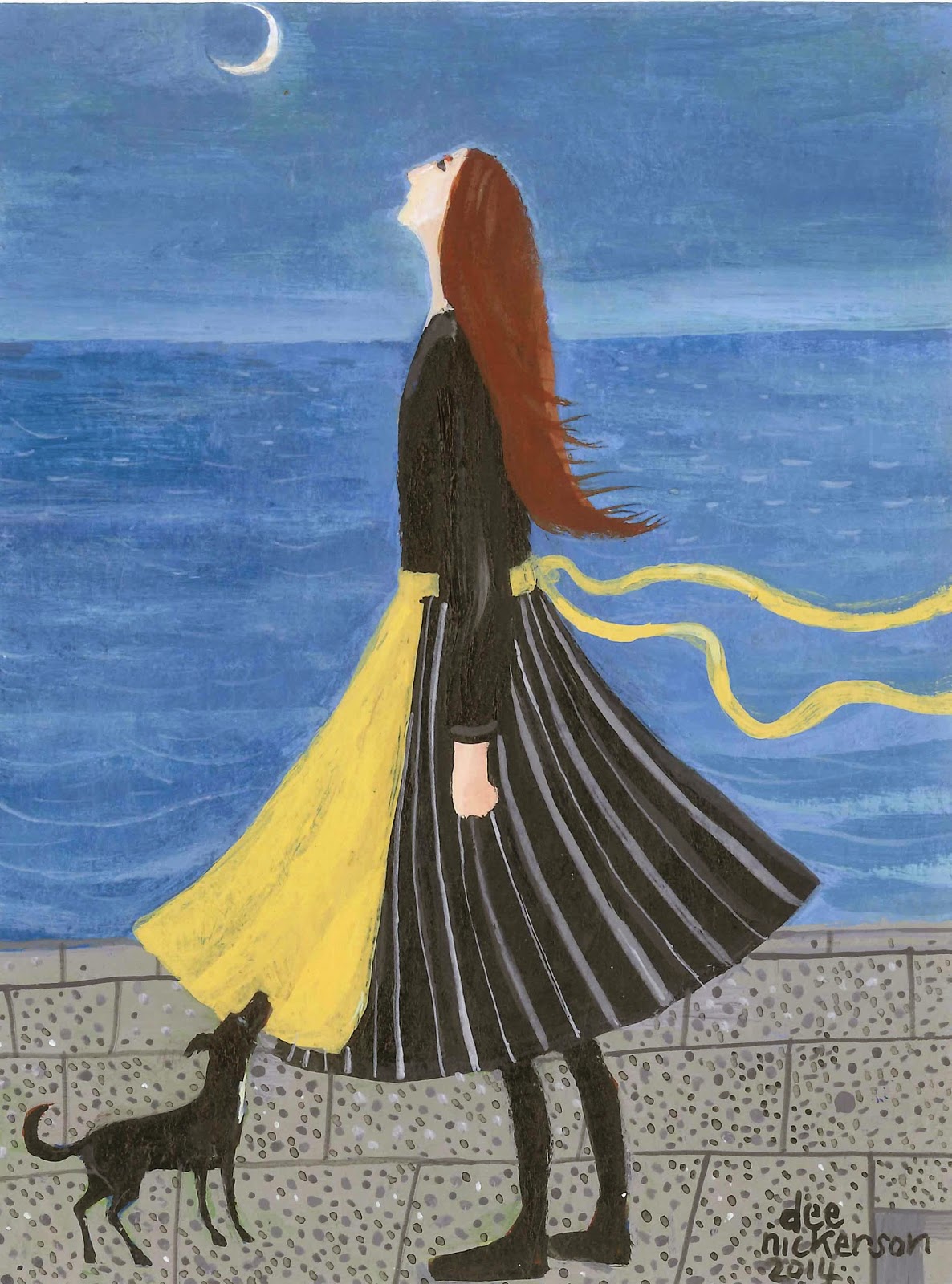
Obra de Dee Nickerson
CAUTIVERIO

El cuarto tiene pocos muebles:
una silla, una mesa, y un padre.

Se sienta en la silla junto a la ventana
libros sobre la mesa.
El momento es siempre justo después del almuerzo.

Pasás en puntas de pie mientras come su manzana
y lee. Levanta la mirada, enojado.
Ha escuchado tu respirar asmático.

Leerá durante años sin alzar la vista
hasta que tu niñez haya terminado:

olores, desorden y preguntas aburridas;
sangre, desde las primeras rodillas raspadas

hasta los primeros muslos manchados.
Estúpidas lágrimas de amor adolescente.

Un día levanta la mirada, complacido
por el producto final.
¡ahora está listo para amarte!

Entonces te induce con voz reservada
a leer a Keats. Vos lo aceptás todo.

Disciplinada en el silencio y el deber,
no le darás causa de reproche.
Se jactará de vos ante extraños.

Cuando la tarde envejece
caen sombras en un cuarto más pequeño
sobre la cama, los libros, el padre.

Le leés en vos alta
"La Belle Dame sans Merci."
Le das su medicina.
Le decís que lo amás.

Esperás a que sus ojos se cierren definitivamente,
entonces podés escribir este poema.


THRALL

The room is sparsely furnished:
A chair, a table, and a father.

He sits in the chair by the window.
There are books on the table.
The time is always just past lunch.

You tiptoe past as he eats his apple
And reads. He looks up, angry.
He has heard your asthmatic breathing.

He will read for years without looking up
Until your childhood is safely over:

Smells, untidiness, and boring questions;
Blood from the first skinned knees
To the first stained thighs;
The foolish tears of adolescent love.

One day he looks up, pleased
At the finished product,
Now he is ready to love you!

So he coaxes you in the voice reserved
For reading Keats. You agree to everything.

Drilled in silence and duty,
You will give him no cause for reproach.
He will boast of you to strangers.

When the afternoon is older
Shadows in a small room
Fall on he bed, the books, the father.

You read aloud to him
“La Belle Dame sans Merci."
You feed him his medicine.
You tell him you love him.

You wait for his eyes to close at last
So you may write this poem.


Carolyn Kizer
(Spokane, Washington, EE.UU., 1925-2014)
PREMIO PULITZER DE POESÍA 1985
en De la nieve, los pájaros - Poesía de mujeres norteamericanas,
Ril Editores, Santiago, Chile, 2010
Compilación Lisa Rose Bradford
Traducción de Luciana Beroiz
para leer MÁS

23 de junio de 2014

Pat Mora, 2 poemas 2


Fotografía de Madalina Iordache-Levay

MUJERES DEL DESIERTO

Las mujeres del desierto sabemos
sobrevivir.
Calores y fríos feroces
han quemado y engrosado
nuestra piel. Como cactus
hemos aprendido a acaparar,
echar raíces profundas,
parecer dormidas, y despertar
al perfume de la suavidad
en el aire, esconder
dolor y pérdida a través del silencio,
ninguna rama llora
o murmura nuestros tristes cantos
seguras tras las espinas.

No se engañen:
al florecer, asombramos


DESERT WOMAN

Desert woman know
about survival.
Fierce heat and cold
have burned and thickened
our skin. Like cactus
we've learned to hoard,
to sprout deep roots,
ro seem asleep, yet wake
at the scent of softness
in the air, to hide
pain and loss by silence,
no branches wail
or whisper our sad songs
safe behind our thorns.

Don't be deceived.
When we bloom, we stun.


s/d del autor de la fotografía

AMOR CON CHAMPAÑA

Las yemas de mis dedos se deslizan
por la verde frescura de la botella
sin sentir la efervescencia encorchada
burbujas juguetonas empujan
contra el vidrio
se chocan, ruedan, explotan
con un deleite despreocupado, placer
presurizado, como mi alegría
que burbujea, burbujas contra mi piel.


LOVE LIKE CHAMPAGNE

My fingertips slide down
the cool, green bottle
never feel the fizz
capped inside, playful bubbles
push against the glass
bump, roll, pop
in carefree delight, pressurized
pleasure, like my joy
bubbling, bubbling against my skin.


Pat  Mora 
(El Paso, Texas, EE.UU, 1942)
en Los usos de la imaginación - Poesía de l@s latin@s en EE.UU
EUDEM, 2008 /Introducción, selección y traducción: 
Lisa Rose Bradford y Fabián Osvaldo Iriarte
para leer 
MÁS
su WEB

9 de enero de 2014

Silvia Curbelo, 2 poemas 2


Fotografía de Hellen Van Meene

CLIMA TURÍSTICO

Todo el verano los huracanes
con nombres de estrellas de cine
iluminan el mapa del clima
a lo largo de cuatro condados. Manejamos
en silencio a la salida del hospital
hacia las callecitas donde
los negocios con nombres de barcos
venden todo a mitad de precio.

...
Los caracoles son huesos. Me puse
tu viejo piloto. Todo lo que suena
en la radio del auto pertenece
a la lluvia. El clima es la única
noticia que vale la pena esperar.
La otra noche la enfermera joven
abrió de par en par las ventanas
poco antes de que golpeara la primera tormenta
y entre los árboles pudimos oír
el rudo hablar de las olas,
un lenguaje sin ternura.

...
Artesanías, caracoles, piedras.
Algunas cosas son más
que sus nombres.
Como los huracanes. O el cáncer.
Una palabra como ésa puede matarte.

...
Una caracola apoyada en el oído
no dice nada. La lluvia cae
entre las grietas de lo que
queremos decir. La otra noche
soñé que agua fresca llenaba mi boca
y mi propia voz, adentro a la deriva,
se alzaba hacia vos
como cualquier sed humana.


TOURIST WEATHER

All summer long hurricanes
with the names of movie stars
ligth up the weather map
across four counties. We drive
in silence out of the hospital
and towards the small strips
where souvenir shops with nautical names
are selling everything half price.

...
Shells are bones. I've put on
your old raincoat. Whatever
plays on the car radio belongs
to the rain. Weather is the
only news worth waiting for.
Last nigth the young nurse
threw open all the windows moments
before the first storm hit
and through the trees we could hear
the coarse talk of the waves,
a language without tenderness.

...
Drifwood, seashell, stone.
Some things are more
than their names.
Like hurricanes. Or cancer.
A word like that can kill you.

...
A shell held to one's ear
tells nothing. Rain falls
between the cracks of what
we mean to say. Last nigth
I dream cool water filled my mouth
and my own voice, adrift inside it,
held itself up to you
like any human thirst.


Fotografía de Ben Evans

EL LAGO DEVORÓ EL CIELO POR COMPLETO

Algunos sueños son como cristales
o como una luz bajo la superficie del agua.

Una joven llora en un jardín.
Una mujer da vuelta la cara y eso es todo.

Nos despertamos cien veces
sin saber dónde estamos. Dormidos

al volante. A salvo
por la gracia de los ángeles.

Todos con dedos contra labios
ante algo más inmenso, la marca del agua

por un enorme dolor. Todos
entregándonos. Así

como la rosa resigna su tallo
y flota a la deriva, sin historia.

Al final, cada camino conduce
al agua. Lo que queda de un jardín

es su sueño, un alfabeto del deseo.
La sombra de la joven. Perfume.


THE LAKE HAS SWALLOWED THE WHOLE SKY

Some dreams are like glass
or a ligth beneath the surface of the water.

Agirl weeps in a garden.
A woman turns her head and that is all.

We wake up a hundred times and
don't know where we are. Asleep

at the wheel. Saved by
the luck of angels.

Everyone touching his lips
to something larger, the watermark

of some great sorrow. Everyone
giving himself away. The way

the rose gives up the stem and
floats completely, without history.

In the end every road leads
to water. What is left of a garden

is the dream, an alphabet of longing.
The shadow of the girl. Perfume.

(de The Secret History of Water, Anhinga Press, 1997) 


Silvia Curbelo 
(Matanzas, Cuba, 1955)
en Usos de la imaginación: Poesía de l@s latin@s en EE.UU.
EUDEM, Mar del Plata, 2008
Introducción, selección y traducción: 
Lisa Rose Bradford y Fabián Osvaldo Iriarte
para leer más en POETRY FOUNDATION
Related Posts Plugin for WordPress, Blogger...